Event 1
Discovery and identification of Elisabeth Gertraud Bräuer’s remains
The discovery and identification of [Elisabeth Gertraud Bräuer](entity:character-recall-character-elisabeth-gertraud-4d634ed304af)’s remains turns a concealed death into a documented case without resolving who was responsible. The remains were found at an abandoned factory near Zeißstraße in November 1971; a fingerprint identified Bräuer, while the subsequent failure to prove the case against the principal suspect left the central question unanswered.
## Discovery at the abandoned factory
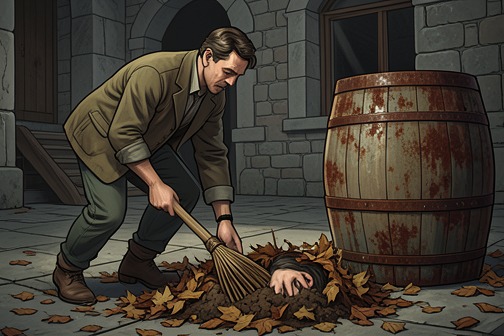
On November 2, 1971, at about two in the afternoon, caretaker Herr Engel was raking leaves in the courtyard of the [Abandoned Chocolate Factory on Gaußstraße](entity:location-recall-location-534ea940fab8). Near an empty wooden barrel, two tables had been stacked one atop the other. Several empty, partly rotted cardboard boxes lay beside them. Beneath the boxes, among leaves and loose earth, Engel saw a head. After noticing a hand as well, he called the police.
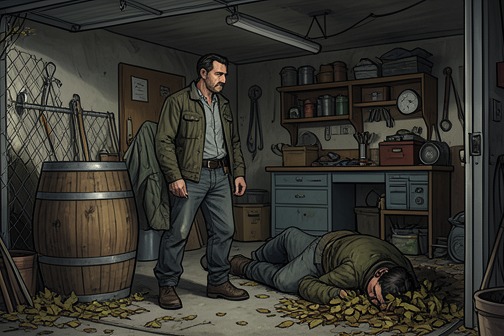
At half past two, patrol car Peter 23 was directed to the construction site on Gaußstraße; the homicide squad arrived shortly afterward. The precise findspot was a cluttered corner at the southern end of a corrugated-metal garage. The remains lay beside a large wine barrel, directly against the property’s boundary fence. The sequence—from ordinary groundskeeping to the discovery of a head and hand, then the arrival of police—marks the abrupt transition from an overlooked pile of debris to a murder investigation.
## The remains and their identification
Investigators found six severely decomposed body parts belonging to a woman. They were wrapped in newspaper and, in some cases, plastic. The reported parts were the head; the left thigh with part of the lower leg attached; the right arm, with the rounded end of the upper-arm bone exposed; the left arm; and the right foot with parts of the lower-leg bones still attached. The last established newspaper issue among the wrappings was the Bildzeitung of November 4, 1970.
The remains were estimated to have been at the site for about a year, but investigators thought the factory was probably not where the woman had died. The surviving physical details were fragmentary: the skin had turned mainly dirty brown and yellow-brown, a trace of fine hair may have been present above the upper lip, and remnants of medium- to dark-blond hair remained on the scalp. The hair appeared to have been cut roughly to about three centimetres, not styled into a particular coiffure. These observations helped describe the unidentified woman but did not, on their own, establish who had killed her.
A usable fingerprint was recovered from the right little finger. Comparison with the police fingerprint collection matched it to Elisabeth Gertraud Bräuer, who had previously been fingerprinted after a theft. She had been 42 at the time of her death, 1.75 metres tall, and slim. After her fiancé died, she led an unsettled life, often choosing men with homes of their own and living with them for a time while keeping house. Identification thus joined the forensic evidence to a brief outline of her circumstances, though neither her past living arrangements nor the location where her remains were deposited answered where she had died or who had killed her.
## Suspicion and an unresolved case
[Winfried Schuldig](entity:character-recall-character-winfried-schuldig-b4c6f5ed17e0) initially became the urgent suspect. Bräuer had been the principal witness in a separate case against him for bodily injury resulting in death. In that case, she had testified that during a dispute between Schuldig and Stern on January 19, 1970, Schuldig struck Stern on the head several times with the back of a chair; Stern was dead the next morning. Schuldig was placed under surveillance for several days after the discovery of Bräuer’s remains.
The surviving account of Bräuer’s interrogation includes her description of a later confrontation with Schuldig. She said he threatened to finish her off so that no one else could have her, and that she fought free of his grip around her throat. According to her account, he then calmed down and ordered her to leave. The interrogation was stopped because she was exhausted and unable to continue; it was to resume the following day. Her testimony therefore supplied a specific history of conflict and violence, but it did not by itself establish that Schuldig had killed her.
Schuldig was acquitted because the killing could not be proved against him. The acquittal closed the case against that suspect for want of evidence, not the question of responsibility. The narrative leaves the reader with the same unresolved problem that follows the identification: Bräuer’s remains have a name, and suspicion has a history, but her killer is not established.
Event 2
Winfried Schuldig Found Not Guilty
[Winfried Schuldig](entity:character-recall-character-winfried-schuldig-b4c6f5ed17e0)’s acquittal turns on the disappearance of a crucial witness and leaves a second, more troubling question open: what happened to [Elisabeth Gertraud Bräuer](entity:character-recall-character-elisabeth-gertraud-4d634ed304af)? Bräuer had been the principal witness in the case against Schuldig after Stern died from injuries allegedly inflicted with a chair back. When she could not be found before the main trial, the case proceeded without her; the court ultimately acquitted Schuldig for lack of evidence. The account then links that failure of proof to the unresolved question of Bräuer’s death without establishing who killed her.
## The case and its missing witness
Schuldig was initially suspected in a case of bodily injury resulting in death. The accusation concerned a dispute between him and Stern on January 19, 1970. According to Bräuer’s account, Schuldig struck Stern on the head several times with a chair back; Stern was dead the following morning. Bräuer was the principal witness against Schuldig, making her absence from the trial consequential to the prosecution’s case.
Immediately before the main hearing, Bräuer was untraceable. The trial therefore went ahead without her testimony. Her disappearance did not itself establish what had happened to her, nor did the account show that Schuldig was responsible for it. But it changed the evidentiary circumstances: the witness whose account connected Schuldig to the fatal assault was no longer available to give evidence in court.
## Sawatzki’s testimony
Anneliese Sawatzki testified about her relationship with Schuldig, whom she had met in [Hamburg](entity:location-recall-location-da109bb5ffb9) in March 1970 while staying at a convalescent home for mothers. She said that they drank together at the Rode in Groß Borstel, after which she went with him to his garden house. She later moved in with him. Her account described a relationship in which his behavior changed when he was drunk: she said he beat her with a piece of wood, leaving bruises across her body, and that she believed it was the same chair back used in the attack on Stern. She also testified that Schuldig could not find peace over the incident and wept when they spoke about it. These were Sawatzki’s claims in court, not a finding that independently proved the earlier assault.
Sawatzki further described financial control and violence. She said Schuldig demanded most of the money she received, often waiting outside her workplace on payday, and that fear led her to hand it over. She also testified that he pressured her to take part in sexual acts she refused. Her evidence portrayed repeated abuse rather than a single isolated confrontation, while remaining distinct from direct proof of the charge involving Stern.
She recounted a particularly severe assault on November 10, 1971, after she and Schuldig had been drinking whiskey in the garden house. According to her testimony, he struck her twice on the head with an ox-whip, tore off her clothes, and continued attacking her. He pinned her down and pressed his knees into her stomach while threatening to finish her. She managed to break free of his hold; he then calmed down and told her to leave. The examination had to be stopped because she was exhausted and could no longer continue, with her questioning due to resume the following day.
## Acquittal and unresolved questions
The court acquitted Schuldig because the act could not be proved against him. The account does not describe a conviction or establish that Sawatzki’s testimony resolved the case. Instead, the outcome follows the central evidentiary loss: Bräuer, the principal witness to the fatal assault on Stern, was absent, and the remaining material was insufficient for proof.
The acquittal closes the courtroom question without closing the narrative’s larger mystery. The account immediately asks who else could have killed Bräuer. That question is left unanswered: it supplies neither an identified killer nor evidence that Schuldig murdered her. The juxtaposition makes the acquittal consequential beyond the case against him. A witness whose testimony had once placed Schuldig at the center of another man’s death is missing, and the legal failure to prove the charge leaves both her fate and the identity of her killer unresolved.
Event 3
Gerda Voss Controlled and Exploited by Fritz Honka

[Fritz Honka](entity:character-recall-character-fritz-honka-9d6af7c2a817)’s control and exploitation of [Gerda Voss](entity:character-recall-character-gerda-voss-6f11d33f89c4) turn a drunken invitation into confinement, forced labor, and prostitution. The relationship moves through sharply different forms of captivity: first the locked apartment and the withheld identity card, then the fish factory, and finally a home in which [Gerda](entity:character-recall-character-gerda-e264fc170c07) is made to serve [Fiete Honka](entity:character-recall-character-fiete-honka-eb7b85406ca0) while he imagines himself generous. Her eventual departure with a stranger ends his immediate hold over her, but the account gives no assurance of what becomes of her afterward.
## From the bar to confinement
Fiete Honka asks Gerda to come home with him from the [Zum Goldenen Handschuh](entity:location-recall-location-zum-goldenen-handsch-f8a48e990da4). She agrees at once. He sends her outside to wait about fifty metres down the [Reeperbahn](entity:location-recall-location-90f1edd9818b), saying he will follow in ten minutes, then spends his remaining money on two double shots of grain liquor. It is bitterly cold, and Gerda has only a thin coat over her work smock. When Fiete eventually looks for her, she is near a sausage stand; a passing smell of bratwurst offers some relief from the wind. He is angry that she did not wait where he had instructed, but Gerda has reached the limit of her patience. They set off together for his home, a walk of roughly two and a half kilometres that the exhausted pair take far more slowly than he expects.
After they return, drinking replaces any ordinary welcome. Fiete alternates two records, [Es hängt ein Pferdehalfter an der Wand](entity:expression-recall-expression-es-h-ngt-ein-pferd-e61b614d5493) and [Es geht eine Träne auf Reisen](entity:expression-recall-expression-es-geht-eine-tr-ne-76a95fb2420a). There is no food, though Gerda is hungry and afraid to complain because she has no money. That night, Fiete takes her identity card, calling it security and collateral. The next morning, before leaving for work, he locks her inside and takes the card with him. A document that establishes her identity becomes part of the mechanism that restricts her movement; the locked door makes the dependence immediate and physical.
## Domination in the apartment
Fiete’s control is not presented as a single act but as a daily arrangement in which Gerda’s needs and choices are made subordinate to his. She tries to make the apartment more bearable by cleaning it. When Fiete comes home to a cleaner room, he is moved to tears and rewards her by taking her out to the Zum Goldenen Handschuh. He treats this outing as evidence of his own generosity, despite having confined her in the apartment and withholding the means to leave independently. At the bar, the two drink heavily. Watching Gerda keep pace, he worries about the cost and decides that she must work.
His thoughts turn toward enslavement with pleasure. When Gerda tells him she has a daughter, Rosi, he becomes interested less in their relationship than in the prospect of meeting her. Gerda describes Rosi as a thirty-year-old who works in a butcher shop, and gives an affectionate account of her appearance and scent. Fiete turns this into an elaborate sexual fantasy, imagining Rosi displayed as meat for sale and Gerda presenting her to him. The fantasy makes his outlook unmistakable: he recasts both women as objects available for his appetite, even though Rosi is not present and he never meets her.
The daily abuse becomes explicit when Fiete demands that Gerda collect her fallen dentures. He makes her repeat the word for teeth before allowing her to gather them, then tries to repair the dentures with glue. When his attempts fail, he throws them down, threatens to give her only food she can manage without teeth, and strikes her again when she cries. Gerda gathers the pieces and puts them in a cup. The next day she searches the apartment for something to eat and tries to mend the dentures herself, eventually finding cement glue that holds them together. Hunger and the damaged dentures are not incidental discomforts: they show how completely Fiete’s power reaches into the most basic conditions of her survival.
## Forced work and sexual exploitation
As days dissolve into heavy drinking, Fiete sends Gerda to work in a fish factory. She adjusts to the physically demanding job, but the money she earns does not give her independence: every Friday she hands it over to him and receives a small treat in return, such as sweets or filter cigarettes. The exchange makes her labor another part of his control. She works, surrenders the wages, and is given only a token reward.
When Fiete suffers another serious workplace accident, including a broken pelvis and a double fracture of the nose, he spends six weeks in hospital. Gerda goes to the [Elbschlosskeller](entity:location-recall-location-elbschlosskeller-5e6b1712107a) after work, as she had done before. One night an older man offers her ten marks to take him home. Soon she stops going to the factory and goes only to the cellar. The apartment becomes a brothel: Gerda has sex with elderly men who come and go, while the household and her sense of what she can manage seem to disintegrate. The account does not frame this as a stable escape from Fiete’s exploitation; prostitution emerges within the same precarious life, with Gerda unable to see a way forward and fearing that Fiete may beat her to death.
## Departure and narrative significance
Gerda finally asks a visiting man from Hanover whether she can go with him. He agrees, and she leaves with him; after that, her trail disappears from the account. The ending is a departure, not a documented recovery. It breaks the immediate arrangement in which Fiete confines her, takes her wages, and determines what work she does, but it does not reveal where she goes or whether she reaches safety.
The episode’s progression—from the borrowed identity card to the locked apartment, from wages surrendered every Friday to men brought into the home—shows control operating through both confinement and economic dependence. Fiete’s self-image as a benefactor sharply contradicts the conditions he imposes: he takes Gerda’s documents and freedom, then regards an outing or a small treat as proof of kindness. Gerda’s labor, hunger, damaged dentures, and eventual disappearance give the story’s account of exploitation its concrete measure. Her exit comes not through a negotiated release but through a chance offer from someone passing through, leaving her fate unresolved.
Event 4
1967 Closure of the Suez Canal

The [1967 Closure of the Suez Canal](entity:event-recall-event-1967-50c20bcd8d0f) is a distant political crisis with immediate, prolonged consequences for the Von-Dohren shipping business: ships caught in the canal could not move, and the uncertainty over when it would reopen became a mounting financial burden. The episode also marks a sharp contrast with the earlier success of Wilhelm Heinrich 2, whose business had prospered through East–West barter deals.
## Causes and Background
Egypt closed the canal in 1967 in response to the Six-Day War. Ships that happened to be inside the waterway when it shut remained trapped there. The narrative presents the closure not as a brief interruption but as an imposed condition whose duration no one could predict.
That vulnerability fell on a company already facing other pressures. Wilhelm Heinrich 2 had initially made a fortune as a major beneficiary of trade between West German firms and the German Democratic Republic. In these barter arrangements, the eastern state obtained goods such as steel that it could not source in the required quality from Russia; completed ships were then sold to West German shipowners, while specialist shipbrokers collected enormous commissions. This profitable business had already ended abruptly by the time the canal crisis is described, amid the company’s wider reversals.
## The Trapped Fleet
One of the eleven ships in the Von-Dohren fleet was stuck in the canal. The text places it among the vessels caught there by chance, rather than suggesting that the entire fleet was stranded. As the years passed, what had first seemed like an absurd historical joke became a sustained predicament: by the time of the scene, the ships had been held for seven years.
The vessels’ appearance gives the episode its name. Wind carried fine yellow desert sand onto their decks, so that the trapped ships became known as the Yellow Fleet. The image turns an abstract geopolitical decision into a visible mark of waiting: the ships remained in place while the sand accumulated and the political outcome remained beyond the company’s control.
## Financial and Personal Consequences
The immobilized ships cost the company immense sums. The Yellow Fleet had become a plaything of unpredictable politics, and no one dared say how much longer it would remain there. The closure thus made uncertainty itself part of the financial damage: the company could neither plan around a definite reopening nor know how long the expense would continue.
For Wilhelm Heinrich 2, the episode belongs to a broader collapse rather than standing as its sole cause. Business misjudgments, poor management, lost fortune, and the belated recognition of the container revolution had also weakened the firm; the canal crisis added another heavy burden. Approaching sixty, he no longer believed he could pull the business out of its difficulties. He felt his energy was spent and gave himself, at most, another year or a year and a half. The stranded ships therefore connect an international event to a private sense of time running out.
Event 5
Trial of the Fritz Honka Case
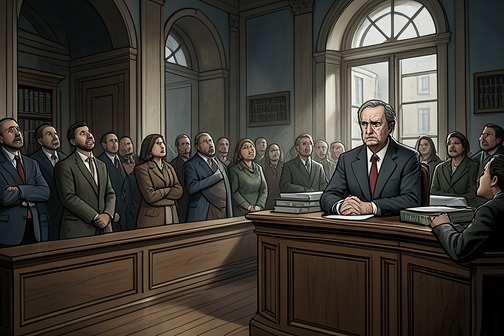
The [Trial of the Fritz Honka Case](entity:event-recall-event-fritz-honka-3f740125ccb9) is the 1976 proceeding that made [Fritz Honka](entity:character-recall-character-fritz-honka-9d6af7c2a817) a figure of grim public fame. The available account identifies the trial as spectacular, but does not describe its hearings, evidence, verdict, or sentence; its significance here lies in the public notoriety it brought to a killer whose victims came from the same marginal world as he did.
## Background and Public Attention
Fritz Honka is described as a serial killer from [Hamburg](entity:location-recall-location-da109bb5ffb9)’s lowest social stratum, physically and mentally marked by a childhood of abuse and violence. He took his victims from the [Zum Goldenen Handschuh](entity:location-recall-location-zum-goldenen-handsch-f8a48e990da4), a bar frequented by people living at the edge of society. The account places the trial against that background, linking the public event to the lives of the bar’s patrons and to the brutal circumstances surrounding Honka.
## The 1976 Trial
The proceeding took place in 1976 and is characterized as spectacular. No details are supplied about the trial’s course or outcome, so the account establishes neither particular courtroom revelations nor the terms of any judgment. What it does establish is the trial’s immediate public consequence: it brought Honka gruesome fame.
## Significance in the Novel’s Social World
The trial’s notoriety does not make Honka the only person rendered visible. The novel’s wider framing stresses that both perpetrator and victims were known to the courts, and follows a night world of bars, deprivation, and violence with historical precision and compassion. Its movement between that world and the wealthier circles of a Hanseatic shipping dynasty sets the suffering associated with Honka’s case beside forms of human failure elsewhere in society. The trial marks the point at which a crime rooted in a marginal community becomes a public spectacle, without erasing the humanity of those caught up in it.
Event 6
Fiete's Escape from East Germany
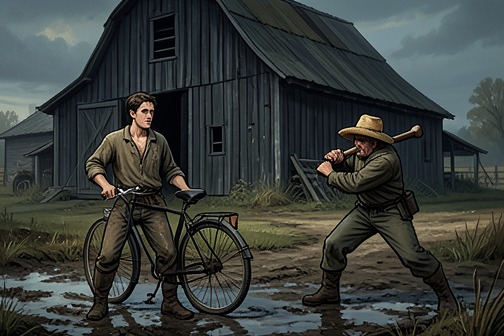
[Fiete Honka](entity:character-recall-character-fiete-honka-eb7b85406ca0)’s 1951 flight from the East Zone, undertaken when he was sixteen, is the beginning of a journey from political displacement into another form of captivity. Years later, while alone with Helga and answering her questions about his past, he recounts how his search for a place in the West brought him to agricultural work in [Billwerder](entity:location-recall-location-136d9d259ee4)—and to [Bauer Frerk](entity:character-recall-character-bauer-frerk-c87e6ea630dc), the man who turned that apparent refuge into a daily ordeal.
## The Flight and Its Immediate Aftermath
Fiete’s story starts with his departure from the East Zone in 1951. He was sixteen and, as he tells Helga, fell into the hands of the wrong person. The brief account gives no route or details of the crossing; its emphasis falls instead on what awaited him after he fled. In Billwerder, he initially found irregular employment in agriculture with Bauer Frerk, a foothold that soon proved to be another trap.
## Work Under Bauer Frerk
The farm’s violence was not presented as an isolated punishment or the consequence of a particular mistake. Fiete says that Frerk beat him every day, using fists, clubs, and even a manure fork. The account describes an employer whose hostility required no special occasion: Frerk hated Fiete in particular, as well as everything more generally. To Fiete, the stables became a dark, devouring place that consumed his physical strength. His flight from the East Zone had brought him west, but it had not brought him safety.
## A Second, Failed Escape
After two months, Fiete tried to get away from the farm on Frerk’s old, battered bicycle. This was a separate escape attempt from his earlier flight out of the East Zone. A police car happened to be patrolling the area at that hour; the narration stresses how extraordinary the coincidence seemed to Fiete. The officers returned him to Frerk, placing him back in the hands of the person who had been beating him.
That return marked a further descent rather than a rescue. Frerk moved Fiete into a tiny, soaking-wet room on the farmhouse’s threshing floor, tied him to his bed at night, and sometimes came without warning to check the knots. The account links Fiete’s repeated nighttime bed-wetting to Frerk’s punishment: he pressed the boy into his own urine. Fiete was also fed partly rotten turnips and potatoes, green meat, and foul water. The escape from the East Zone thus opens a sequence in which flight repeatedly fails to secure freedom, and the police intervention makes his immediate captivity worse.
## The Recalled Episode
The episode reaches the reader through Fiete’s account to Helga. She has asked what brought him to [Hamburg](entity:location-recall-location-da109bb5ffb9) and what he had done before; it has been a long time since anyone asked him something personal. His answer gives their conversation a new depth, but it also sets his trust beside the brutality he describes. The narrative moves from his teenage flight to the farm and then to the failed bicycle escape, making the distinction between leaving the East and escaping Frerk essential: Fiete accomplished the first, but the second ended with his return to the abuser.
Event 7
Fiete Returned by Police After His First Escape from Frerk's Farm
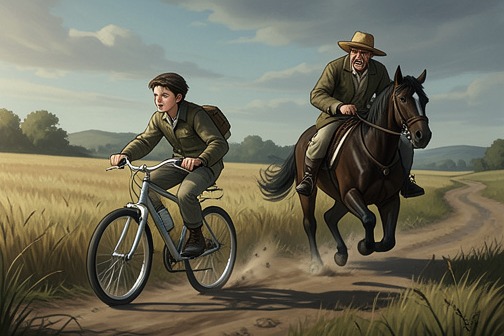
Fiete’s first escape from [Bauer Frerk](entity:character-recall-character-bauer-frerk-c87e6ea630dc)’s farm ends not in freedom but in forced return: after fleeing on an old bicycle, the sixteen-year-old is handed back to the man who has been beating him. Recalling the episode to Helga years later, he describes a failed flight that turns the farm from a place of brutal labor into a prison of deliberate confinement and daily torment.
## Background and First Escape
Fiete tells Helga that in 1951, aged sixteen, he fled the East Zone and ended up with the wrong person. He initially found irregular agricultural work with Bauer Frerk in [Billwerder](entity:location-recall-location-136d9d259ee4), but Frerk’s violence soon made the arrangement a trap. Day after day, Frerk struck him with fists, clubs, and a manure fork, without needing any particular provocation; the account presents his hatred as general, but especially directed at Fiete.
After two months, Fiete tried to escape on Frerk’s old bicycle. The farm’s stables had seemed to consume all his strength, and the bicycle offered a chance to get away from them. Instead, a police patrol happened to be driving through the area at that hour. The officers caught Fiete and took him back to Frerk, reversing his attempt to leave and placing him once more in the farmer’s power.
## Return and Escalation
The return marks a sharp worsening of Fiete’s treatment. Frerk moved him into a tiny room off the main hall, which Fiete describes not as damp but as wet. At night, Frerk tied him to his bed and sometimes came without warning to check that the knots held. When Fiete wet himself, Frerk punished him by pressing him down into the urine.
The misery is rendered through relentless repetition: everything is wet, cold, and soaked. His food consists of half-rotten turnips and potatoes, green meat, spoiled vegetables, and foul water. Frerk continues devising new humiliations, so that Fiete’s captivity is not merely a return to the same violence but an escalation into calculated, sustained degradation.
## Significance in Fiete’s Recollection
Years later, Fiete recounts this episode to Helga after she has shared her worries about her low-paid cleaning work and the mortgage she and Erich may not be able to repay. Her personal questions prompt him to speak about a past that, as the narration observes, few people have asked him to describe. The memory exposes the history behind his arrival in [Hamburg](entity:location-recall-location-da109bb5ffb9): at sixteen, he was a runaway from the East Zone who found work only to be abused, returned by the police, and trapped again.
The episode’s decisive reversal is stark. The officers’ intervention does not rescue a vulnerable runaway; it restores him to the person harming him. That return makes the farm’s subsequent confinement and degradation possible, and gives Fiete’s later account of his past a concrete history of violence and failed escape.
Event 8
Fiete's Second Escape from Frerk's Farm and the Tractor Collision
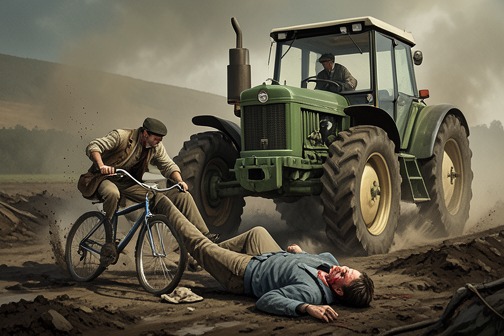
[Fiete Honka](entity:character-recall-character-fiete-honka-eb7b85406ca0)’s Second Escape from [Bauer Frerk](entity:character-recall-character-bauer-frerk-c87e6ea630dc)’s Farm and the Tractor Collision is the episode in which an attempt to flee captivity becomes a near-fatal act of violence. After enduring confinement and abuse, Fiete breaks free and rides away, but Bauer Frerk pursues him with a tractor, knocks him from his bicycle, and leaves him in the mud without seeking medical help. The injuries nearly kill Fiete; his eventual rescue and prolonged hospitalization mark the cost of his escape.
## Captivity and the Escape
The flight follows a period of escalating abuse at Bauer Frerk’s farm. Fiete has been moved into a tiny, soaking-wet room, tied to his bed at night, and punished when he wets himself. His food consists of rotten vegetables, bad water, and spoiled meat. He has even tried to hang himself, but circumstances on the farm repeatedly prevent him from doing so. The escape is therefore not a casual bid for freedom: Fiete believes he may last only another week or two under these conditions.
One early morning, with less than half an hour before Bauer Frerk is due to get up, Fiete manages to free himself and sets off on a battered bicycle. For a time he thinks he may be safe. Then he hears the engine of Bauer Frerk’s Fendt tractor behind him. A straight road runs between water-filled ditches, and a narrow entrance to the woods lies ahead; the tractor cannot follow through it, while Bauer Frerk’s war-injured hip would make pursuit on foot difficult. The woods seem close enough to offer a way out.
## The Collision
Fiete pedals desperately toward the woodland path. The narration counts down the remaining distance—ninety metres, then eighty, seventy, and onward—turning escape into a race measured against the tractor’s approach. Before Fiete can reach safety, Bauer Frerk rams the bicycle. Fiete is thrown through the air and strikes a fence post, then lies bloodied in the mud.
Bauer Frerk gets down from the tractor and inspects the injured boy. Rather than call an ambulance or a doctor, he returns slowly to the farm. The scene makes the collision more than a failed escape: Bauer Frerk leaves Fiete without help, intending that he should suffer before he dies. The bicycle, rendered unusable in the impact, is the only loss Bauer Frerk appears to regret.
## Injuries and Survival
The collision leaves Fiete with a fractured skull base, deep cuts on his thighs, and a destroyed upper set of teeth; fragments of the broken teeth remain lodged in his upper jaw. He is not found until twenty-five hours later, by which time he is barely alive. For days his survival remains uncertain. During treatment, tar and small pellets are painfully washed from his wounds.
Fiete spends three months in [Ginsterhof Hospital](entity:location-recall-location-4661fd574061). His nose and teeth cannot be properly restored, so the consequences of the crash persist beyond the immediate danger to his life. Rescue comes by chance, after a delay that makes his survival precarious rather than assured.
## Narrative Significance
The episode reverses the apparent meaning of escape: Fiete reaches the road and comes within a short distance of the woods, yet freedom is answered by a tractor’s force and by the person who had confined him. The countdown of metres gives the attempt a briefly measurable hope, while the abrupt impact converts that forward motion into bodily damage and helplessness. Repeated emphasis on wetness in the preceding captivity gives way to the mud where Bauer Frerk leaves him, joining the farm’s oppressive conditions to the violence of the pursuit.
The account also distinguishes escape from rescue. Fiete can free himself and ride away, but he cannot secure his own safety once Bauer Frerk catches up; survival depends on being found many hours later. The prolonged hospitalization and lasting damage to his face and teeth make the collision a defining consequence of the farm’s abuse, not merely an obstacle in a failed flight.
Event 9
Fiete Raped at the Shelter
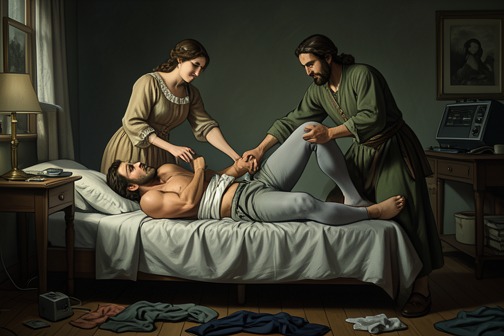
[Fiete Raped at the Shelter](entity:event-recall-event-fiete-c0bd15f6c10a) is a remembered assault that gives a concrete origin to [Fiete Honka](entity:character-recall-character-fiete-honka-eb7b85406ca0)’s later wish for revenge. After he found work on another farm following his attempted murder of [Bauer Frerk](entity:character-recall-character-bauer-frerk-c87e6ea630dc), two women and a man abducted him to a homeless shelter, robbed him, and left him unconscious; when he came to, he had been stripped, bound, and raped.
## Background and Abduction
The assault took place after Fiete had found work on a different farm in the wake of his attempted murder of Bauer Frerk. One evening, two women and a man seized him and took him to a homeless shelter. They took ten marks from him and forced him to drink vermouth—about half a bottle, perhaps three-quarters—until he lost consciousness. The episode was also his first experience of drinking alcohol.
## Assault at the Shelter
When Fiete regained consciousness, the women had taken off his clothes and tied his hands behind his back with a stocking. They held him by the legs while the man raped him. The sequence of robbery, forced drinking, restraint, and rape leaves him without the ability to resist or control what is done to him.
## Recollection and Consequence
The narrative returns to the assault while Fiete is absorbed in violent sexual fantasies and the handling of his pistol. In that later moment, the remembered rape is not presented as an isolated detail: Fiete wants revenge for it and for everything else he believes has been done to him. The recollection links an earlier experience of coercion to the retaliatory violence taking shape in his imagination, without making that connection an excuse for his subsequent conduct.
Event 10
Fiete Assaults Helga Denningsen
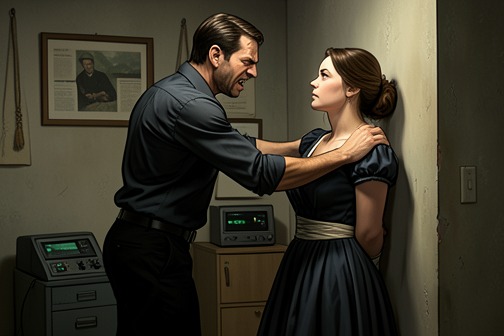
Fiete’s assault on [Helga Denningsen](entity:character-recall-character-helga-denningsen-e9bb00c999ee) turns a brief domestic pause into an act of sexual violence. While Helga’s husband, [Erich Denningsen](entity:character-recall-character-erich-denningsen-157dccbbad89), goes to buy food, Fiete converts her casual account of a family visit into what he imagines is an invitation to claim her; his drunken delay gives that fantasy time to harden into action.
## Background and Trigger
Erich leaves to fetch shashlik and fries from a nearby snack bar. In his absence, Helga tells Fiete that her sister Erika will visit at the weekend because she has often been lonely since separating from her husband. Fiete treats this practical explanation as a coded announcement: he convinces himself that Helga means to separate from Erich and be with him, and that she has mentioned Erika to encourage him to make the first move. Nothing in the conversation supports that interpretation; the meaning is supplied by Fiete’s wishful thinking.</numerusform
## The Assault and Immediate Aftermath
Erich Denningsen remains away longer than [Fiete Honka](entity:character-recall-character-fiete-honka-eb7b85406ca0) thinks a short food errand should take. Fiete imagines that Erich may never return, even fantasizing that he has been killed on the road or by a truck or train, and wishes fervently for that outcome. He sets himself a deadline: he counts slowly to sixty, deciding that if Erich has not returned by then, he will act. The count becomes a torment in itself, but at sixty Erich is still gone.
Fiete Honka has already felt the opportunity as a succession of shocks, yet he keeps postponing action for another drink. When the moment comes, he tells Helga Denningsen that he loves her and wants sex. He tears at her blouse until its buttons burst and damages her bra as well. His attention turns to her exposed body, which he has long tried to imagine; the grotesque comparison he makes to warm pieces of dung exposes the gap between his anticipation and the degrading, objectifying way he sees her. Helga cries out in fear and pain, then strikes him until he releases her.
Helga Denningsen breaks free and runs. Fiete Honka is too drunk to pursue her, and his immediate fear is that she will go to the police, costing him his job and sending him to prison. He locks the door from inside and drinks again, then again, in what the narration presents as a deliberate plunge toward self-destruction. The scene ends with his recognition that, in his own view, everything is now irretrievably over.
## Narrative Significance
The scene’s central reversal is between Fiete Honka’s imagined romance and the reality Helga experiences: what he interprets as encouragement is neither a promise nor consent. His private story makes her ordinary remarks seem to authorize his desire, while her fear, pain, and resistance expose the violence concealed by that self-serving interpretation. The assault therefore marks not a beginning to the relationship he fantasizes about, but the collapse of that fantasy into an act she must physically resist.
The slow count to sixty gives the episode a measure of suspense, but it is a rule Fiete invents for himself, not evidence that circumstances have changed. His repeated postponement for another drink and his final turn back to drinking bind opportunity, intoxication, and failure together. The ending remains confined to his alarm and sense of irreversible ruin: the passage does not establish whether Helga goes to the police or what happens to his job. That unresolved consequence leaves the immediate scene suspended at the point where his imagined control gives way to fear of what he may face.
## Self-Deception and the Limits of the Ending
The episode’s timing is governed less by any change in Helga Denningsen’s behavior than by Fiete Honka’s private countdown. He turns Erich Denningsen’s ordinary absence into a conditional permission: if Erich has not returned by sixty, Fiete will act. The rule gives his decision the appearance of inevitability, though it is Fiete himself who invents both the deadline and the meaning he assigns to it. His repeated need for another drink interrupts that self-dramatization, showing the gap between the decisive moment he imagines and his actual inability to act without delay.
After Helga escapes, the account stays close to Fiete’s fear of losing his job and going to prison, then closes on his sense that everything is over. That ending records his alarm, not a confirmed report of what Helga does next: the passage does not say whether she contacts the police or whether Fiete faces any immediate consequence. The distinction matters because his final conclusion is another private judgment, as subjective as his earlier belief that Helga’s remarks signaled a desire to be with him. The scene leaves his imagined catastrophe and the still-unknown aftermath side by side.
Event 11
WH 3's First Visit to the Zum Goldenen Handschuh Bar
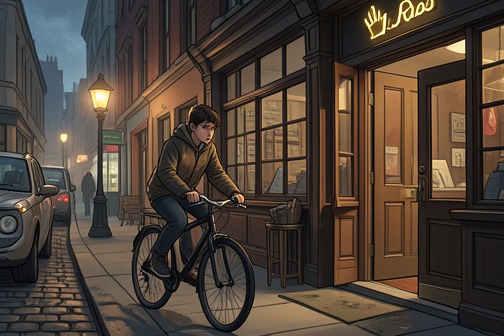
[WH 3](entity:character-recall-character-wh-3-0ec8e59bcc74)’s first visit to the [Zum Goldenen Handschuh](entity:location-recall-location-zum-goldenen-handsch-f8a48e990da4) is a small adventure that changes how he sees himself. He arrives as an inexperienced teenager rehearsing his entrance into adult life; after witnessing violence and encountering the bar’s strange, unembarrassed regulars, he goes home feeling transformed. The episode makes his imagined bravado collide with the place itself, while letting the reader see a world whose inhabitants WH 3 can only begin to interpret.
## The plan and the approach
On a Tuesday evening shortly after ten, WH 3 sneaks out of his house. His previous trips to [St. Pauli](entity:location-recall-location-bafd3f3e508e) had been with his parents to the Operettenhaus, followed immediately by the journey home. This time he is alone, and even the bicycle ride nearly overwhelms him: he is so excited that he almost falls. He has delayed the outing for two weeks, and now intends only to look around, enter a few bars, and become familiar with the terrain before returning on later excursions.
His ambition is bound up with [Petra](entity:character-recall-character-petra-931643728185). He has been turning over ways to impress her, but athletic achievement is out, and his background is no advantage: Petra is from modest circumstances and has made clear that she dislikes capitalists. He longs to turn eighteen so that he can obtain a driving licence, and imagines that even a moped might help, but his parents oppose what they call such machines. Alcohol occurs to him as another possible way to impress her; he has also considered hashish, though he does not know how to get it and has never asked Petra whether she drinks or smokes it. Rather than risk exposing his ignorance, he has avoided the subject. The excursion is therefore both a practical reconnaissance and an imagined performance: he hopes to acquire something remarkable to bring back to Petra, though he does not yet know what that will be.
On [Reeperbahn](entity:location-recall-location-90f1edd9818b), he walks with his head down and a brisk, deliberate step, convinced that his inexperience must be written on his face. He avoids establishments with touts outside, anticipating that they would single him out for ridicule. Across the street, [Hans-Albers-Platz](entity:location-recall-location-296f0cb546d3) is lined with prostitutes; he imagines the humiliating remark one of them might make if he passed close by. At the same time, he entertains a romantic fantasy in which he eventually becomes a regular client of a pretty girl his own age, befriends her, and takes her to dinner or the cinema. His first steps into the district are thus governed by fear of being exposed and by an elaborate wish to belong.
## The street incident and the threshold
Near [Davidwache](entity:location-recall-location-c739c81d1f8b), WH 3 turns into a side street, hoping that a quieter entrance will make it easier to go into a bar. The street is dark, dirty, and nearly deserted; after walking to its far end, perhaps two hundred metres, he finds the bars apparently empty or closed. He turns back towards Reeperbahn. Then a small, potato-shaped man flies out of an open doorway and lands in the street. A second man, wearing a torn shirt marked with blood, rushes after him and kicks him while he is down. The attacker turns on WH 3 as well, challenging him for staring and telling him to go home to his mother.
WH 3’s literal conclusion is that the attacker must have been drinking. The observation is naive, but it does not send him home. The man initially appears to be going back inside, then changes his mind and walks in the direction from which WH 3 has come. WH 3 watches, finds the whole incident interesting, and concludes that there is more happening here than he had expected. He reads the sign above the doorway: Zum Goldenen Handschuh. Without knowing much more about the place, he decides that this is his trial by fire and goes in.
The choice is a reversal of his cautious plan. He had hoped to build confidence by looking into quieter bars; instead, a public assault has drawn him to the very doorway where it began. His first encounter with the bar is not a welcome or an explanation but a body thrown into the street and an insult aimed at him. Yet the violence that might have confirmed his fears also gives him a reason to cross the threshold. The place appears to him as a scene of danger, but also as proof that his tentative outing has become a genuine adventure.
## A bar seen from the outside and within
WH 3 sits at the table to the left of the entrance. [Anus](entity:character-recall-character-anus-5ed56533b2bb) comes over to take his order. WH 3 asks for a Braun’sche Röhre, the school slang for cola, but Anus does not recognize the expression, so he asks for a Coca-Cola instead. Nobody asks him for identification. He watches through the greasy window as the man who was thrown out staggers towards the [Elbe Castle Cellar](entity:location-recall-location-3efdc004e1ad), moving hesitantly and slowly wiping blood from his coat. WH 3 supposes that the two bars must be connected. The inference is described as not entirely wrong, though he does not know the larger network or history of the people around him.
The contrast between what WH 3 sees and what the reader is told is central to the scene. The bar contains [Soldaten-Norbert](entity:character-recall-character-soldaten-norbert-deafbb818334), [Fanta-Rolf](entity:character-recall-character-fanta-rolf-2d4555443a2d), and [Fiete Honka](entity:character-recall-character-fiete-honka-eb7b85406ca0) with Oma, but WH 3 cannot identify them. He is surprised that nobody pays him any attention and thinks that someone like him ought to stand out. Their indifference gives him room to sit and observe; it does not mean that he understands the room. He orders a beer after the cola, reasoning that drinking is something one has to learn and worrying that he might be thrown out if he stretches one drink over the whole evening.
His attention settles on Tampon-Günter, a high-seas fisherman whose reputation is as outsized as his appearance. The narration describes him as a man who can endure almost anything: in January 1969, he went overboard and survived for nearly five hours in the North Sea, in water only just above freezing. He is said to be able to take on a dozen men, sense a change in the weather, and smell out shoals of fish. He comes to the Zum Goldenen Handschuh only four or five times a year and prefers peppermint schnapps and cherry liqueur. [Herbert](entity:character-recall-character-herbert-00821e0faa25) brings him the drinks, and Günter produces two tampons from his coat pocket, soaking one in each glass. Once they have absorbed the liquor, he sucks them dry and hangs the green one over his right ear and the red one over his left, explaining the arrangement through the nautical colours for starboard and port.
Günter’s performance turns a mundane barroom drink into a private ritual and a comic adornment. The guests enjoy it, especially Herbert, who has a deep respect for him. The narration underlines the difference between Günter and anyone else attempting the same act: on another person it would make a fool of him, but Günter carries it off. WH 3 sees only a towering, two-metre-tall man, built like a Viking, with tampons dangling from his ears. He has tried to imagine what the district might hold, but not this. The scene is funny and grotesque, yet its humour depends on a form of authority WH 3 cannot yet read: the spectacle belongs to a regular who is accepted in the room, not to the nervous newcomer watching him.
## The walk home and its afterimage
After the bar, WH 3 imagines that Anus might recognize him next time and set a beer down without being asked. This imagined future regular status matters to him as much as anything he has actually done. Only moments earlier, the place had seemed frightening; now he feels like a new and different person, hardened and worldly. He tells himself that the evening was something real, something that Petra will be astonished to hear about. The change is not an objective proof of maturity but a new story WH 3 tells about himself, built from having gone in, stayed, ordered drinks, and endured the bar’s strangeness without retreating.
On the way back it begins to rain. Old women hurry across the broad street like little black clouds, then duck under cover, while WH 3 savours the air and thinks he can see the curve of the earth between the buildings. This expansive perception follows his night of close observation: a dirty window, blood on a coat, a stranger’s improvised ornaments, and finally the wet city opening into something immense. His first visit has not made him an experienced adult, nor has it brought him closer to Petra in any demonstrated way. It has given him a vivid tale and the feeling of having crossed a boundary. The reader, meanwhile, has seen how much of the bar remains beyond his understanding, making his triumphant self-image both touching and ironic.
Event 12
Public Attempt at Reconciliation at WH 1's Eightieth Birthday

[WH 1](entity:character-recall-character-wh-1-5bf20b142162)’s eightieth-birthday celebration becomes the setting for a public attempt to rehabilitate him, engineered by [WH 2](entity:character-recall-character-wh-2-4d5d2a068772) and delivered by [Gerhard Leyendieker](entity:character-recall-character-gerhard-leyendieker-3f5d000eabd3). The gesture is meant to end two decades of exclusion from [Hamburg](entity:location-recall-location-da109bb5ffb9) society and offer WH 1 a late-life vindication. Instead, the ceremony exposes the distance between the reconciliation others have arranged and the hatred WH 1 still inhabits. He has prepared to confront his former associates, but when the moment arrives, he cannot speak.
## Background and the campaign for reconciliation
With the family business facing bankruptcy, WH 2 wants to accomplish something for his father before time runs out: obtain a unanimous, official absolution and restore him to the standing from which he was excluded. WH 2’s purpose is not simply to secure a ceremonial compliment. He has begun, perhaps to his own surprise, to feel solidarity and something close to pity for an old, broken man who has already lost much and whose old mistakes continue to be held against him. Reconciliation is an unfamiliar impulse in him, but he believes twenty years of banishment from Hamburg society are enough.
For almost a year, WH 2 patiently cultivates the people whose agreement matters. He approaches Peter Marquardt, chair of [Verein Deutscher Reeder](entity:organization-recall-organization-verein-deutscher-e2f8b83a6a92); maritime coordinators Ernst von Telkow and Raimer Moritz, responsible for lobbying in Bonn; and Peter Vossbuhr, head of [Vereinigung Hamburger Schiffsmakler und Schiffsagenten](entity:organization-recall-organization-vereinigung-hamb-ad438e714fb3). Gerhard Leyendieker is the last person he must persuade. Born in 1895, the same year as WH 1, Leyendieker went to the same school as him. Their relationship has passed from friendship to rivalry and then to estrangement. WH 1 still hates Leyendieker with all the force he can muster; for Leyendieker, by contrast, WH 1 has become a person who no longer matters.
WH 2 waits while Leyendieker talks with Bertram Theissen, the head of Hapag Lloyd. The two men dislike one another and disguise their hostility with exaggerated, false cordiality; on this occasion they shout over each other as if the antagonism were a joke, though it is not. WH 2 holds back until Leyendieker addresses him. Theissen, already heavily drunk, eventually gives way and leaves. Leyendieker then agrees to the rehabilitation, presenting it as time to bury the conflict and insisting that even a grave mistake can be forgiven. He adopts the part of a magnanimous, softened-by-age peacemaker. They decide that WH 1’s approaching eightieth birthday will be the occasion, and that Leyendieker himself will bring him the news.
## The public ceremony
WH 1 is the only person who has not been told that his rehabilitation is coming. The gathering catches him off guard: prominent guests have assembled, including the interior senator. WH 2 has arranged to explain the purpose of the occasion only at five minutes to twelve, leaving his father no opportunity to protest beforehand. The timing makes the public gesture difficult to refuse without first having to confront it before the assembled company.
The celebration takes place in oppressive heat. The temperature is already close to thirty degrees; sunlight breaks across the river, and the air seems to boil. At noon, Gerhard Leyendieker makes his way to the microphone, exhausted by the short walk, sweating and visibly struggling to remain upright. He grips the lectern and gives one of his three standardized speeches, a familiar performance whose wording has been settled in advance.
He begins with Hamburg’s standing as a port, praising its infrastructure and connections to the hinterland while acknowledging the difficulties of the long approach up the Elbe and the tide’s effect on heavy ships. From there he turns to the obligations of the Hanseatic merchant tradition and the need to accept the globalization of trade. He recalls the construction of the first container terminal at Burchardkai and mentions that Aristotle Onassis had a tanker built in Hamburg in the 1950s. The speech is padded with tedious jokes, including familiar remarks about the difficulty of understanding women. Its businesslike port history and prepared humor delay the occasion’s real purpose: the tribute to WH 1’s life’s work.
That phrase carries a troubling implication. There is little to say about WH 1’s postwar years, and the narrative suggests that Leyendieker’s reference to his life’s work must reach back to WH 1’s role during the [Nazi Era](entity:time-recall-time-9f7124ebd523). Leyendieker nevertheless manages to steer the speech to its conclusion. He shakes WH 1’s hand with conspicuous solemnity, warmth, and duration. The handshake is not merely a sign of peace: it is also staged as a gesture of domination, turning the public act of reconciliation into a physical encounter WH 1 has not chosen.
## The speech WH 1 cannot deliver
WH 1 has spent his strength saving himself for this moment. He has rehearsed the response a thousand times and arranged it in exact sequence. He would begin with flag registration: the practice of registering ships in Liberia and other countries to save money. In his furious, nationalist conception, shipowners who did this were betraying Germany, and he planned to draw a parallel with military deserters. The planned speech would then move from public accusations to claims about dirty deals and illegal business, including transactions associated with Café Lausen and Susis Show Bar, and the way commercial agreements were celebrated with visits to brothels.
After exposing what he regarded as the respectable men’s hypocrisy, WH 1 intended to turn on the people around him one by one. He had insults and curses prepared for Margot, [August](entity:character-recall-character-august-3c55407d5a64), his son, and his grandson; in his imagination, the reckoning might last for hours or even days. He also imagines what could follow his denunciation: the others might beat him to death, hang him upside down in a cold room among frozen carcasses, and leave his body until its blood darkened and its entrails congealed. This is not a speech he actually makes, nor an assault that takes place. It is the elaborate private script of a man who has preserved his anger as if it were his last remaining power.
When the moment comes, nothing comes out. WH 1 is old, paralyzed, exhausted, and spent; he has waited too long. The lethargy, weakness, and senility that he had once only pretended to possess have entered him without his noticing. Instead of the denunciation he has rehearsed, his throat produces a steady, low snoring sound, like a rough foghorn. Leyendieker looks at him and waits. When WH 1 says nothing, Leyendieker releases his hand and strides toward the buffet.
## Consequences and significance
The ceremony gives WH 2 the public outcome he worked to secure, but it does not produce a mutual reconciliation. WH 1 neither feels honored nor grateful; the intended act of release lands as a slap in the face because it mistakes him for someone ready to be reconciled. His hatred and fantasies of revenge have become so settled that he could not simply exchange them for forgiveness, even if he wished to. Yet by the time he might have voiced that refusal, his body has failed him. His silence is therefore neither acceptance nor a triumphant restraint: it is the consequence of a decline that has overtaken the performance of weakness he once controlled.
Afterward, WH 1 listens to his heartbeat and feels his body jolted by its dull, light blows. He no longer wants to go on living. His thoughts turn toward vanishing—being hurled against a wall by a violent gust, dissolving, or being swallowed by the earth—and he longs only to be gone. The public occasion intended to restore his place instead leaves his private despair exposed to the reader, even as it remains unspoken to the guests. WH 2, meanwhile, is immensely relieved that everything has gone smoothly as far as the ceremony is concerned. He expects to get through the rest of the afternoon and evening, after which quiet will return for a long time. That relief sharpens the event’s central irony: the family’s formal success and WH 1’s inner defeat coexist, without bringing father and son, or former friends, into genuine accord.
Event 13
Oil Tanker Market Collapse Triggered by the Oil Crisis
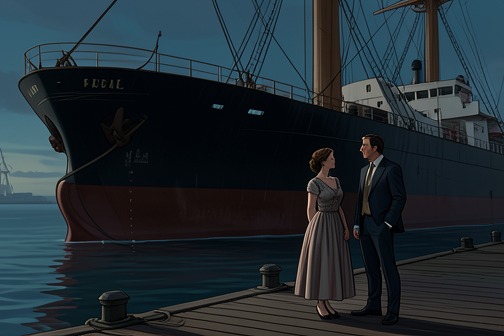
The oil tanker market collapse triggered by the oil crisis transforms a ship commissioned at the height of the boom into a daily financial burden for [Reederei von Dohren](entity:organization-recall-organization-reederei-von-doh-7b3225b48f64). In a conversation between [Margot von Dohren](entity:character-recall-character-margot-von-dohren-eafccdec8de8) and [Karl von Lützow](entity:character-recall-character-karl-von-l-tzow-0a1c672bbde4), the stranded tanker Susanne makes the crisis concrete: the company’s pride earns nothing while costing thousands of dollars each day.
## Causes and Background
In 1971, at the height of the tanker boom, [WH 2](entity:character-recall-character-wh-2-4d5d2a068772) ordered a ship for the family shipping business. By the time the vessel was delivered, the market had changed sharply. The oil crisis sent the price of a barrel of crude from three dollars to forty, and tanker prices fell drastically. The ship arrived into a market transformed between its commissioning and its delivery.
## The Susanne and the Company's Losses
The Susanne lies in a remote bay, unable to earn money. Instead, it costs the company thousands of dollars every day. Described as the pride of Reederei von Dohren, the tanker has become an emblem of the gap between the ambitions of the boom and the financial reality that followed: a major investment remains physically present, but produces no return.
## News Shared at Dinner
Margot raises the situation with Karl as a matter of concern while they discuss what is happening at the office. Karl nods and assumes a solution will be found. He would rather not hear about such difficulties, but interprets Margot’s willingness to mention this one as evidence that it is not too serious; he believes she would not trouble him with a truly grave problem. The exchange shows the crisis entering their private conversation in the form of a manageable business worry, even as the ship’s daily costs continue to accumulate.
Event 14
Anna’s Murder
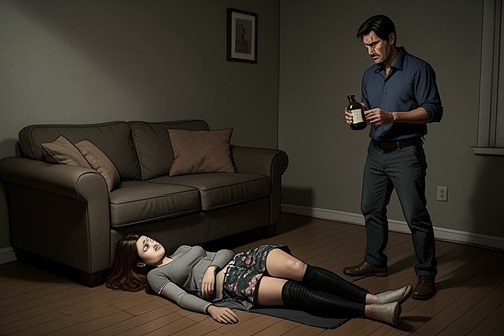
[Anna](entity:character-recall-character-anna-ea2421a71401)’s murder is the decisive end of her confinement in [Fiete Honka](entity:character-recall-character-fiete-honka-eb7b85406ca0)’s apartment, where physical collapse, alcohol, sexual violence, and Fiete’s attempts to manage the consequences converge in a killing. The scene makes the murder more than a sudden act: Anna’s suffering is prolonged, Fiete repeatedly treats her condition as an inconvenience to be endured, and after killing her he tries to erase both her body and the language he associates with her abuse of him.
## Confinement and Collapse
Anna has been living in Fiete’s apartment for almost a week and has not managed to go outside. On his Friday off, Fiete leaves her there while he takes his uniform to the cleaners on Bahrenfelder Straße, buys room spray and scented stones at Budnikowsky, and drinks at the nearby Schultheiß-Quelle. He thinks of Anna as a badly burned, nearly dead creature and imagines that she may die before he returns. Her death by itself has already become, in his thinking, one possible way for the situation to end.
Anna has drunk almost two bottles of Korn. She lies awkwardly between the sofa and the floor, her body described as pliant and artificial, while the air in the unventilated apartment presses on her. She has no children, relatives, money, or home of her own; even memories seem to her like a human possession she has forfeited. Her immediate wish is to burst apart, and her anger turns toward Fiete for leaving her alone in the heat and stench. She drags herself to the toilet, where brownish-red urine passes but her hardened stool does not. These details establish the bodily crisis before Fiete’s violence: Anna is already gravely debilitated, but she remains furious, distressed, and capable of resistance.
When Fiete comes home, he finds that Anna has put on the worst scraps from the collection of women’s clothing in the apartment. The narration presents his response through a torrent of demeaning descriptions: he sees her as mad and monstrous, as though something repulsive were emerging from her. Anna curses him, inventing insults as well as using familiar ones, and hurls a succession of glasses, followed by a plate and a bowl, against the wall. The outburst is described as a final, mysterious reserve of energy in a creature close to death. Fiete silently gathers the broken pieces and hopes that she will calm down, that the police, a doctor, or the fire brigade will come, or that his brother [Siggi](entity:character-recall-character-siggi-ea5751c081f1) might arrive. His wish for outside intervention does not become action on Anna’s behalf.
## Neglect, Sexual Violence, and Escalation
Anna falls asleep on the bedroom bed. Later, under cramps, she defecates; when Fiete tries to turn her and clean up, she knocks the bucket from his hands and rolls in the filth. He leaves the room and drinks. Once she is quiet, he checks on her and finds her staring at the ceiling with her eyes wide open. He eventually persuades her to get up so he can strip and clean the bed. He scrubs the room and stuffs the soiled bedding into garbage bags, then sits with Anna on the sofa and opens another bottle of Korn. His muttered reassurances are meant to keep her calm, in particular to prevent her from soiling the living room as well. Even his care is framed by the management of mess and inconvenience.
The next turn is Fiete’s sexual arousal. The narration emphasizes the disturbing contradiction between Anna’s condition and his desire: she has been severely weakened, is surrounded by filth, and has only just fallen asleep, yet he wants to continue. He sprays an entire can of pine-needle deodorizer around the apartment and distributes scented stones in the corners before drinking again. When he returns to Anna, she is asleep and unresponsive. He shakes her shoulders; she presses her legs together with all her strength. Her refusal and his rage form the immediate trigger for the assault. The text does not present the killing as an accident or as an act required by her physical condition: Fiete responds to her resistance with deliberate violence.
## The Killing
Fiete pulls Anna’s head up and strikes it repeatedly against the bedside table. She asks him to let go, and blood seeps from the back of her head. He reaches under the bed for a stiff, encrusted rag and forces it around her neck. As he strangles her, his hatred takes the form of a wish that she should not escape so easily. He loosens his grip when she turns red, then blue and purple, and resumes after she coughs and gasps. The repeated tightening and release prolong the violence. He uses his hands and watches for the transition into death, intent on noticing each detail; Anna’s body convulses and kicks before it finally becomes still.
Afterward, Fiete sits on the edge of the bed and stares ahead, physically motionless. At dawn, as a thin rain begins, his anger rises again. He blames Anna for the filth in his bed and for the insults that had come from her mouth. He takes a kitchen knife and cuts her throat, pursuing the idea that speech resides there and that her vocal cords must be destroyed. He then covers her eyes with the rag, acting on the belief that the dead may still see, and places a towel on the floor to catch the blood. The sequence links his fear of being seen by the dead with his effort to eliminate the part of Anna he associates with speech. It does not undo the killing; it extends his violence into an attempt to control what remains of her.
## Mutilation and Concealment
The following day, Fiete is again overcome by anger, which he assigns entirely to Anna. He cuts off her breasts and removes part of her vagina. He places the removed body parts, together with a pullover and skirt, on the corpse, bends her legs, and ties her thighs with parcel string so that the body will fit into the alcove. This handling of Anna’s body is both mutilation and practical preparation for concealment: Fiete intends to move her there temporarily, not to seek help or report her death.
The corpse’s smell eventually threatens the concealment. Two weeks later, Fiete seals the alcove hatch with strips of Leukoplast and papers over it with wallpaper. That delayed measure gives the event a grim aftermath beyond the murder itself: the apartment is not simply the site where Anna dies but also the place where Fiete hides the evidence of her body. The progression from leaving her without care, to killing her when she resists, to cutting and concealing her body shows how the domestic space becomes an instrument of control. Anna’s final destruction is accompanied by Fiete’s attempt to suppress her voice, her presence, and the trace she leaves behind.
Event 15
Frida's Murder
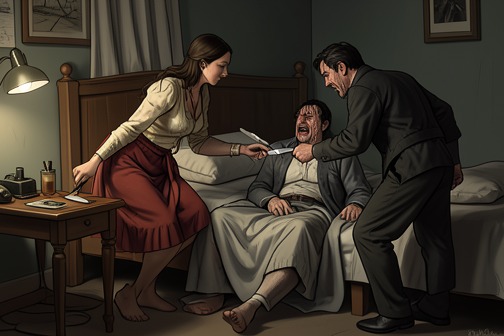
[Frida's Murder](entity:event-recall-event-frida-0aed4f6ad8ac) turns an attempt at resistance into a killing by [Fiete Honka](entity:character-recall-character-fiete-honka-eb7b85406ca0), whose sexual violence and possessiveness have left Frida too injured and exhausted to flee. The scene pivots on a knife, a sudden counterattack, and four hundred D-Mark hidden in a bra: the money's discovery precipitates the strangling, after which Fiete tries to erase the evidence and soothe himself with a repeated appeal to God, his mother, and Christ.
## Background and Immediate Trigger
After two comparatively quiet days, Frida is made to endure another of Fiete's sexual assaults. The narration conveys the pattern through her exhausted calculation that it cannot continue much longer and that he will eventually kill her. Her thought, framed as a choice between him and herself, becomes the immediate prelude to resistance. The episode presents no safe route out: even when Fiete is incapacitated, Frida does not know where she could go and feels too battered to make it down the stairs.
Frida reaches for a potato-peeling knife lying on the small table beside the bed. The object is ordinary, but its presence gives her a means to interrupt the assault. She stabs at Fiete; he turns aside quickly enough to avoid a wound to the chest. She then kicks him in the testicles with the pointed heel of her sandal. The pain makes him lose consciousness. For a moment, the balance of power has reversed: Fiete is helpless, and Frida could attempt to leave. Yet the narrative makes clear that opportunity alone does not amount to escape. Her uncertainty about where to go and her physical condition keep her in place until he wakes roughly two hours later.
## The Discovery and the Killing
Fiete's injury remains severe when he comes to. He examines it and puts his testicles in cold water, keeping them there for what the narration describes uncertainly as hours or minutes, but long enough to mark his disorientation and pain. When he returns to the living room, Frida is wearing a bra. He treats the change as suspicious, tears it off, and discovers four hundred D-Mark concealed in its right cup.
The discovery changes the scene's course. The money is identified as all of Fiete's money, and the narration gives it several possible meanings: capital for a new life, payment for sex, and compensation for pain. These descriptions do not establish Frida's intentions; they show how the money becomes charged in Fiete's perception. His response is immediate and fatal. Reaching for a cloth, he sees hatred in Frida's face; she struggles to throw him off, but he manages to brace himself against the bedside table, loop the cloth around her neck, and pull it tight. The woman who has just wounded him and hidden money from him is killed by him in the same room.
## Aftermath and Concealment
After Frida is dead, Fiete turns her onto her stomach so that, as the narration puts it, she cannot look at him. He drinks, then takes a kitchen knife and cuts at his own testicles. The act is presented as an attempt to attack the part of his body he regards as the source of his curse, but he does not carry through his wish to cut off his penis. He trembles and stops short. The sequence places his self-directed violence after Frida's killing without confusing the two: he has killed her, while his threatened mutilation remains incomplete.
The next morning, Fiete intends to put the body in a storage recess but finds it full. He wraps a rope around the corpse and attaches it to a roof beam, then begins removing traces of what happened. During this work he croaks a plea that, when he stands before God, he will be judged as not having wanted the deed, and that before his mother and Christ he can claim to be pure. He repeats the reassurance from the beginning. The repetition follows the practical work of concealment; it does not undo the killing or stop him from hiding the body.
## Narrative Significance
The scene is structured around reversals that are brief but consequential. Frida's attack momentarily disables Fiete, yet her inability to leave allows him to recover. The hidden money then makes visible a conflict over possession: Fiete treats the discovery as a violation and responds by killing the person who hid it. The event does not present her resistance as a successful escape; it shows how physical exhaustion, fear, and the absence of a destination narrow the possibility of action even after she has fought back.
The aftermath sets bodily violence beside moral self-exoneration. Fiete turns Frida away from his gaze, tries to injure his own body, hides hers, and repeats a claim of purity before imagined religious judges. His words are reported as a recurring plea, while his actions supply the contradiction: he is actively concealing the death he says he did not want. The scene ends not with confession or relief but with concealment and repetition, leaving fear in the air as the remaining consequence.
Event 16
WH 3 and Petra's Night of Estrangement at the Zum Goldenen Handschuh
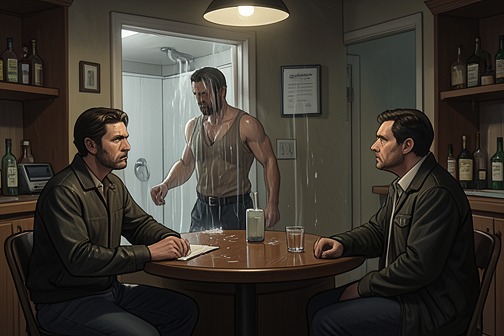
[WH 3](entity:character-recall-character-wh-3-0ec8e59bcc74) and [Petra](entity:character-recall-character-petra-931643728185)’s night at the [Zum Goldenen Handschuh](entity:location-recall-location-zum-goldenen-handsch-f8a48e990da4) turns a hoped-for final outing into a decisive estrangement. WH 3 reads her return and suggestion of another place as a possible opening, while Petra understands their year of friendship as something he has mistaken for romance. His disappearance into the lavatory becomes the night’s brutal hinge: he is sexually humiliated there, she leaves, and he comes upstairs drenched and alone. The scene sets the collapse of his hope against Petra’s clear rejection and the indifferent routines of a bar where, for a moment, their lives intersect with [Karl von Lützow](entity:character-recall-character-karl-von-l-tzow-0a1c672bbde4)’s.
## The invitation and WH 3’s hope
Petra returns, and WH 3’s heart lifts, but joy is immediately shadowed by fear that she might change her mind, vanish, or become involved with someone else. She asks about the bar he had mentioned and suggests they could go there after all. Instead of taking this as a simple proposal, he fixates on the phrase meaning “after all”: perhaps it means one last drink, followed by each of them going their separate way. He is uncertain how to read the phrases and moods exchanged at this hour, and the uncertainty gives an ordinary plan the weight of a possible farewell.
The destination is the Zum Goldenen Handschuh, whose crowd, drunkenness, fights, noise, and bodily squalor make it an uneasy place for him to bring Petra. Yet he cannot think of another option, and feels he has no choice if she wants to go. His anxiety is both emotional and physical. His bladder is painfully full, and he has to leave for the toilet immediately. When Petra asks what people drink there, he answers that she can have whatever she wants. She chooses vodka and asks if he will have one too. He dreads another shot, feeling it may be the one too many, but silently nods rather than refuse.
In the lavatory, the urinal is occupied, so WH 3 waits behind a large, red-haired man. The stench of urine and excrement, the press of bodies, and the man’s loud self-congratulation as he relieves himself make the wait feel interminable. WH 3 is still trying to finish when the room suddenly empties. He reassures himself that only a few minutes have passed and that Petra must still be there. His attempt to steady himself exposes how much the evening has become a test of whether she will stay.
## Assault in the lavatory
The reprieve is short. Heavy, clattering footsteps come down the stairs; WH 3 moves aside so as not to obstruct whoever is approaching, following the deference he learned from his parents. When he looks back, he sees one or more men behind him. He tries a frightened smile, hoping to convey that he is weaker and should be left alone. Instead, they mock his appearance and order him to keep facing the wall.
A zipper sounds, and one of the men urinates on him. WH 3 does not turn around or resist. The stream runs down his legs and into his shoes, gathering in a steaming puddle on the floor. The assailant continues to taunt him, ordering him to stand still and keep going while using a slur against him. When finished, the man taps two fingers against WH 3’s temple in a pantomime of a gunshot and leaves. The gesture makes the assault both bodily and openly threatening, while WH 3 remains powerless to prevent it.
He retreats into a filthy stall, strips off his soaked trousers, and tries to wring them out. They are so wet that pulling them back on is difficult. He anticipates that the urine will make his legs red and that the clothes will begin to smell. These are not incidental indignities: when he finally returns upstairs, the assault is still written on him in the wetness he cannot hide. The separation from Petra is therefore not simply a matter of competing expectations. It takes place alongside an attack that leaves him physically degraded and emotionally exposed.
## Petra’s interpretation and departure
While WH 3 is gone, Petra grows angry at the length of his absence. She thinks he might as well rot in the toilet and wonders what could have happened, but dismisses the idea that she should go searching for him in a place foul with old urine and excrement. To her, coming to the bar had been a last attempt to avert something she had sensed approaching throughout the evening: the moments when his restraint seemed to be failing. She had noticed his skin growing hot, his breathing quickening, and the pulse in his neck; when this happened, she had gone for drinks, danced, or used the toilet.
Petra now recognizes that she had badly misjudged their friendship. After a year, she had considered it impossible that WH 3 wanted something more, but she believes he has been continually restraining himself and pretending to accept their relationship as it was. She also reinterprets his earlier exaggerated coolness when she greeted him with a friendly embrace: what she had taken as distance was, in her view, an attempt to conceal his feelings. The narration makes the divide stark. What he experiences as devotion, she finds intrusive and needy; she resents the assumption that her friendship might offer him a romantic chance. Petra does not want the exclusivity and dependence she associates with being in love and wants to retain her freedom to choose.
The evening’s physical separation confirms the emotional one. Petra sets down her empty glass, waves to Karl von Lützow, and leaves the bar. She does not go to the lavatory to look for WH 3. Her departure is not presented as a response to the assault, which she has not witnessed; it follows her own impatience and her settled conviction that his attachment has become a burden. Her absence is thus the answer WH 3 feared when he heard her suggestion of a final stop, although he cannot know her full reasoning as he waits below.
## Karl’s passing encounter and WH 3’s collapse
Karl von Lützow has entered the bar only moments after WH 3 went downstairs. He arrives exhausted and disillusioned, resolving that the night should be his last attempt to pursue fleeting desires. A woman from the countryside had let him put an arm around her before leaving with people like herself, and he takes the failure as a sign to accept reality. He imagines instead a quiet, comfortable life in his bungalow, taking over the gardening, going on excursions and bicycle rides, and perhaps one day finding a love that is returned. He orders two double Boonekamp drinks because he does not know what else to have.
For an instant, the two men’s stories touch without meeting. Karl and Petra exchange a toast across the bar; each regards the other as normal. Meanwhile, WH 3 is being urinated on below. Petra leaves, Karl finishes his second drink, briefly considers following her, then keeps to his resolve and goes in the opposite direction. Only seconds later, WH 3 stumbles upstairs in soaked clothes. The parallel is pointed: Karl’s decision to abandon pursuit at least gives him a direction to follow, while WH 3’s hope has depended on a person who has already walked out.
WH 3 had known she might be gone, but knowing does not prepare him for finding the bar without her. His insides flutter; tremors pass through him, and he can barely suppress hysteria. His thoughts circle through violent, self-destructive possibilities as he tries to keep moving. The narrative compares him to a headless chicken still running, an image that turns motion into a sign of disorientation rather than escape. He leaves the Zum Goldenen Handschuh and wanders through the surrounding streets, registering fragments such as a man with a walking stick, a battered car, and a half-full beer bottle in the gutter.
His despair hardens into rage against the drunken, battered, impoverished people around him. He blames them for their dependence and imagines a world rid of them, even as he himself is unraveling in public. Beneath the insults, the narration locates the source of the crisis in his unrealizable desires: he recognizes his dreams as hopeless and unrealistic and treats longing as the source of conflict and suffering. The scene ends not with reconciliation, explanation, or a grand gesture, but with him running as fast as he can, making hollow, impaired sounds, while his heart’s capacity to leap and hope is rendered useless. The night’s rejection is therefore both intimate and grotesque: Petra is gone, the assault has left its mark, and WH 3’s movement carries him away without bringing him closer to anything he wants.
Event 17
Discovery of Human Remains at Zeißstraße
The [Discovery of Human Remains at Zeißstraße](entity:event-recall-event-zei-stra-e-1b00d226db17) was the turning point that exposed the killings hidden at [Zeißstraße 74](entity:location-recall-location-zei-stra-e-74-f8df93965a5f). During firefighting on [July 17, 1975](entity:time-recall-time-1975-7-17-1a1ad6e6fd7c), firefighters found body parts in a side space beneath the attic roof; what they uncovered pointed to homicide and quickly focused suspicion on night watchman [Fritz Honka](entity:character-recall-character-fritz-honka-9d6af7c2a817).
## Discovery during firefighting
The remains came to light in the course of firefighting, not during a search for a suspected killer. Their location in the attic’s side space transformed an otherwise practical operation into the discovery of evidence of a violent crime. The finding established that the matter was not an accident or an unexplained disappearance: the body parts indicated a homicide.
## Suspicion and confession
Suspicion soon centered on the forty-year-old Fritz Honka, a night watchman. He initially remained silent for days. On [July 29, 1975](entity:time-recall-time-1975-7-29-6b2b5b9c193c), in questioning by criminal investigators Peter Seeler and Hans-Peter Untermann, he finally confessed to the murders. The interval between discovery and confession marks the event’s immediate investigative course: physical evidence first exposed the crime, and questioning then brought Honka’s admission.
## From hidden crime to public case
The discovery made the killings a matter of investigation and, ultimately, of criminal proceedings. Its consequences extended beyond identifying a suspect. In the legal context that followed, Honka’s defense became part of a wider dispute about whether a sexually deviant offender should be treated as criminally responsible or as ill and in need of psychiatric care. The prominent defense attorney [Rolf Bossi](entity:character-recall-character-rolf-bossi-df989ba25e1d), who had previously helped provoke that debate through his defense of [Jürgen Bartsch](entity:character-recall-character-j-rgen-bartsch-1bc6f16807e0), took on Honka’s case only three weeks before the trial began. The remains found during firefighting thus mark the point at which concealed violence entered both the investigative record and a contested public discussion of criminal responsibility.
Event 18
Fritz Honka's Trial and Verdict
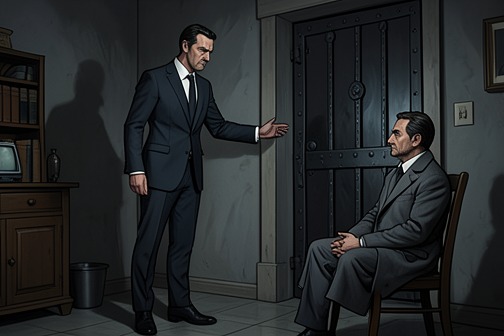
[Fritz Honka](entity:character-recall-character-fritz-honka-9d6af7c2a817)’s trial and verdict turned on two competing accounts of responsibility: the prosecution charged him with four murders, while his defense argued that chronic alcohol abuse, psychological disturbance, and the circumstances of his life had diminished his culpability. The court ultimately convicted him of one murder and three manslaughters, sentenced him to fifteen years in prison, and ordered his placement in a psychiatric hospital. The case made the boundary between criminal responsibility and mental illness central to the judgment.
## The Defense and Its Psychiatric Question
The trial entered a debate already sharpened by [Rolf Bossi](entity:character-recall-character-rolf-bossi-df989ba25e1d)’s earlier defense of [Jürgen Bartsch](entity:character-recall-character-j-rgen-bartsch-1bc6f16807e0), a convicted child murderer. At Bartsch’s trial five years earlier, Bossi had helped provoke a bitter discussion about what psychiatry could explain and what criminal law should punish: whether a sexually driven offender was a criminal answerable for his acts or a sick person requiring psychiatric treatment. That question returned with particular force in Honka’s case, where the defense sought to make mental illness and diminished responsibility more than abstract legal categories.
Bossi took on Honka’s defense only three weeks before proceedings began. In his closing argument, he presented his client as a man wholly ruined by alcohol abuse and emphasized Honka’s desperate attempts to struggle against his fate. Bossi urged the court to consider that fate before judging guilt. He described the killings as situational or milieu-related acts, pointing both to Honka’s personality development and to the severe insults the victims had allegedly directed at him. He further argued that Honka suffered from a serious mental abnormality with pathological significance, and characterized the dismemberment of the bodies as the product of a necrophilic-sadistic frenzy. On that basis, Bossi sought a finding of diminished responsibility under Section 21 of the German Criminal Code.
## Findings, Sentence, and Institutional Aftermath
In its judgment of [December 20, 1976](entity:time-recall-time-1976-12-20-6aa408ac66fb), the [Hamburg](entity:location-recall-location-da109bb5ffb9) Regional Court found that the forty-year-old night watchman had been proved guilty and had confessed to killing four women in his third-floor apartment at [Zeißstraße 74](entity:location-recall-location-zei-stra-e-74-f8df93965a5f), Hamburg 50, probably to satisfy his sexual desires. The judgment identified the victims and methods: [Gertraud Bräuer](entity:character-recall-character-gertraud-br-uer-105fa6bdb67b) was strangled in late 1970; [Anna Beuschel](entity:character-recall-character-anna-beuschel-798f47c538f0) was beaten and strangled, and her throat was cut, in October 1974; [Frida Roblick](entity:character-recall-character-frida-roblick-790264fa9e63) was strangled in early December 1974; and [Ruth Schuld](entity:character-recall-character-ruth-schuld-40a0fb622d5c) was strangled in January 1975. The four deaths were thus presented not as an undifferentiated pattern but as separate crimes extending across more than four years.
The court did not accept the prosecution’s four murder charges in full. It convicted Honka of murder in one case and manslaughter in three, each offense committed with diminished responsibility, and imposed an aggregate prison sentence of fifteen years. It also ordered his placement in a psychiatric hospital. The distinction between murder and manslaughter preserved a finding of criminal guilt while recognizing that his responsibility had been reduced; the psychiatric order placed treatment and confinement alongside punishment as consequences of the verdict.
The reasoning described a profound deterioration following years of heavy alcohol abuse, including organic consequences, compounded by the continuous decline and neglect of Honka’s life and personality. The judgment treated his surrender to sexual compulsion as addiction-like. Its account pointed to the fact that he had continued living in the apartment with the decomposing bodies, their smell persistently present and beetles and maggots established in them, as evidence of that condition. The trial’s final outcome therefore answered the defense’s question neither with full exculpation nor with an unqualified attribution of responsibility: the court convicted Honka, reduced his culpability, and ordered psychiatric confinement.
## The Verdict in the Novel’s Social Landscape
The trial’s formal language of murder, manslaughter, diminished responsibility, and psychiatric confinement sits beside a social world that sorts people through crude nicknames, visible injuries, and assumed worth. At the [Zum Goldenen Handschuh](entity:location-recall-location-zum-goldenen-handsch-f8a48e990da4), [Fiete Honka](entity:character-recall-character-fiete-honka-eb7b85406ca0) takes pride in being given a nickname at all, treating even a second-class one as a distinction; later, the bar’s returning customers include [Inge](entity:character-recall-character-inge-1a4fc30c8d61), [Hildegart](entity:character-recall-character-hildegart-5037d8ab969b), and [Agnes](entity:character-recall-character-agnes-a7e5e75ca8a8), women living by prostitution or petty theft after being pushed to the margins. The contrast does not explain away the verdict or soften the crimes. It shows how the court’s categories of culpability and illness enter a narrative already crowded with people whom their surroundings have reduced to labels, while the judgment insists on naming the acts and assigning consequences.
## Criminal Guilt in the Bar’s Everyday Language
The trial’s formal distinctions between murder and manslaughter have an unsettling echo in the bar’s casual proximity to violence and imprisonment. Early in the novel, Fiete Honka speaks beside a regular known as Leiche, whose real name is Helmut Berger: Berger has served thirteen years for murder, and when someone once asked what kind, he answered that it was “treacherous,” making the others laugh. The exchange reduces a grave conviction to a barroom joke, just as nicknames turn people into instantly legible types. Set against that atmosphere, the verdict’s naming of each victim, offense, and sentence restores a measure of specificity: the crimes cannot remain merely another grim anecdote among the bar’s regulars.